Flickr

If you want to see even more pictures, check out my flickr at:

http://www.flickr.com/photos/willecuador/

Monday, October 15, 2012

Cotopaxi, Quilotoa, and Chimborazo, oh my!

This past weekend, I went with Toby and Marcela to a three day biking tour of some of the most beautiful mountains in Ecuador. I will give a shameless plug here to our amazing tour company The Biking Dutchman. If you are ever in Ecuador, definitely sign up for one of their amazing mountain biking experiences. For our tour we started from Quito and went up to Cotopaxi on day 1, Quilotoa on day 2, and Chimborazo on day 3. From this itinerary you get to see the two highest peaks in Ecuador, and one of the most unique and beautiful crater lakes in the world. Of course the best part is that the whole thing is done on mountain bikes and in car. So you get to ride through the best and most scenic parts of Ecuador, while being driven to each destination. I'm going to do a separate post for each day, but it may take a bit to get everything uploaded so I just wanted to post this to let people know that I'm still alive. Also it's a great opportunity to whet your appetites with some of the amazing pictures I got. Stay tuned for the upcoming blogs!

Cotopaxi national park.

Me, Toby, and Marcy at Quilotoa.

A panorama of Quilotoa crater lake.

A canyon created by the eruption of Quilotoa many years ago.

From the old road from Chimborazo to Ambato.

Another from the old road to Ambato.

Our tour group!

Thursday, October 11, 2012

The City of Needles and Threads

Otavalo is a city like no other, it blends old with new, Quechua with tourist, and beautiful handmade crafts with knock off designer jeans. The importance of Otavalo as a trading post dates back to pre-Incan times, and for hundreds of years it has held one of the most important open-air markets in South America. Every Saturday craftsmen and artisans from the surrounding Andes gather to display everything from jewelry to paintings to bootleg DVDs, and of course, the weaving. By far the most popular items in the market are the stunning cloth goods that come in every shape, size, and color. Alpaca or cotton; sweater or tablecloth; pencil case or hammock; if it is made out of thread and dye, you can find it in Otavalo. And they are beautiful, in fact the challenge here is not finding something you like, it's choosing which of the thousands of rainbow colored blankets you are going to buy.

The goods make it worth the trip, but I have to say that I found the market experience itself to be a bit much. On Saturdays the markets overflows from the Plaza del Ponchos into the surrounding streets and snakes its way through most of the small town. It is just massive, completely packed everywhere you look with cheap bead necklaces, knock off converse shoes, indigenous Quechua clothing, and some of the most random but fascinating crafts I've ever seen. The Plaza del Ponchos is a sea of colors and patterns, bursting with cloth of every type and salesmen hawking their goods. Every way is bustling with a mix of locals and tourists, all hunting for the best bargains. Everywhere you go salesmen and artisans are yelling at you in their best Spanglish and trying to draw you in with discounts and a dizzying display of brightly colored tapestries. If you're trying to induce a seizure, this would be a great place to go. Personally, I found it all a bit overwhelming. First of all, there are just so many stands with amazing works that you want to buy everything you see, but you know that there are probably 50 other stands with exactly the same stuff. How are you to make the right decision... Who has the best colors? The best patterns? The best price? Will this be unique? Will I use it? How will I bring it home?

It's really just too much for me to handle at one time, and it can be difficult to stop, because if you slow down you're likely to be swarmed by the vultures that pass for salesmen here. I really hate salesmen. When I'm shopping I just want to be left alone... just because I stop to look at something does not warrant you to start pulling everything out to show me, or asking me a million questions. If I like something I will buy it, if I want to see something or have a question, I will ask. I also feel a tremendous amount of guilt when I stop to look at things and get these artists hopes up only to walk away the next minute.

But despite all of the insanity of the surroundings, the market is definitely worth it. The finds are top-notch, unique, and beautiful. And the experience is one that is worth having, even if it's not all that enjoyable. It's very cool to see such a mix of cultures and classes all coming together in this big mixing pot of commerce. Plus we stayed with our friends Marco and Lucia, so lodging was free, we ate at their cevicheria, and after the market Marco took us to a beautiful lagoon outside of town. Doesn't get much better than that for a one day trip.

One of the streets in the Plaza de Ponchos.

Breakfast at the food market (yes there's a whole separate market just for food.)

In Ecuador, ceviche is more of a cold soup, and it's eaten with popcorn.

Me and Toby at Quicoche, the lagoon.

It was very cloudy and rainy during our trip, but that makes for a cool effect on the lake.

Those clouds really made this place seem like it was from a movie.

Wednesday, October 3, 2012

Hot Tips for Ecuador: Quito Part 1

Good morning/afternoon/night! There are a lot of miscillaneous things that I've learned from my time so far in Ecuador that I think are worth writing about, but don't necessarily warrent their own blog post. Hence the first installment of my soon to be epic series "Hot Tips for Ecuador." These are the kinds of tips that you can not find in any travel guide; things that I wish someone had told me before arriving, and/or random things that I find funny and want to share. So here goes nothing!

1.) Wear a lot of hair gel. This one is somewhat of a personal choice, but if you're trying to look like a local it's definitely the way to go. Quito is a pretty windy place, and I believe that is what motivates this early 2000s-esque obsession with hair gel. Most Quiteños wear their hair short to medium length, spiked up in a faux-hawk, and always well crusted with gobs of super-hold hair gel. If there's one thing this look accomplishes well (and I'm pretty sure there is only one thing) it is to keep that hairdo in place all day long, through wind, rain, or hurricane.

2.) Don't trust the buses. This one is important, you must always ask the bus drivers where they are going. Buses in Ecuador are not terribly organized. They all just have a sign in the window that is supposed to say where they are going. Though often times the signs are incorrect, or at the very least hard to decipher. I have several times climbed on a bus only to end up in some foreign neighborhood far from my desired destination. Don't get me wrong, there are many things about public transport in Ecuador that I love, in fact I would say that as far as efficiency, Ecuador beats out any major city in the States. You just have to be careful and ask the driver where he is going before climbing aboard. Most drivers are happy to help a confused gringo.
Ecuadorian buses are awesome, notice the transformers symbol in the upper left


3.) Don't climb the walls. People into Quito are very concerned about home-security. Every house is surrounded by an 8 to 10 foot stone wall barred by a metal gate. These old stone walls often look tempting to climb... don't be fooled. Every wall is topped by some combination of barbed wire, electric fence, or my personal favorite: broken glass. Yes Quiteños do recycle their old glass bottles, they are simply repurposed as home-invader deterrents.
An example of the broken glass defense

Ouch!

4.) Watch your step. Here is another important one. Sidewalks in Ecuador are often a disaster. In a lot of places it looks like they just let Jackson Pollock loose on the wet concrete. Potholes, huge steps, big cracks... it's a potential minefield. In my first week here I was tripping every 30 seconds. If you're not careful you will fall flat on your face. This is why when you're walking around the neighborhoods of Quito you HAVE to look at your feet. Always look down, seriously, because if you shift your attention to that passing car you will trip and embarrass yourself. Not to mention that the whole "pooper-scooper" idea never really caught on here, so that's just one more thing to watch out for. I repeat: always look down.

Well, thanks for reading, and stay tuned for part 2 of "Hot Tips for Ecuador: Quito"

Monday, October 1, 2012

Return to Pichincha: The Summit

Frequent readers of this blog may remember that I have been to Pichincha before. Last time it was quite a hike and it seemed that we had made it fairly close to the summit. We were wrong... so very wrong. Pichincha is one of those hikes where you always think "It's just over this next hill!" and it never is. In total the trek to the summit took us 3 hours and 15 minutes, and it was a bitch. The summit is at 4,698 meters (15,413 ft.), the altitude becomes a big factor. During our climb I was huffing and puffing more than Chris Christie climbing the capitol steps. It is also freezing cold with near tropical storm force winds, so that's not helping anyone.

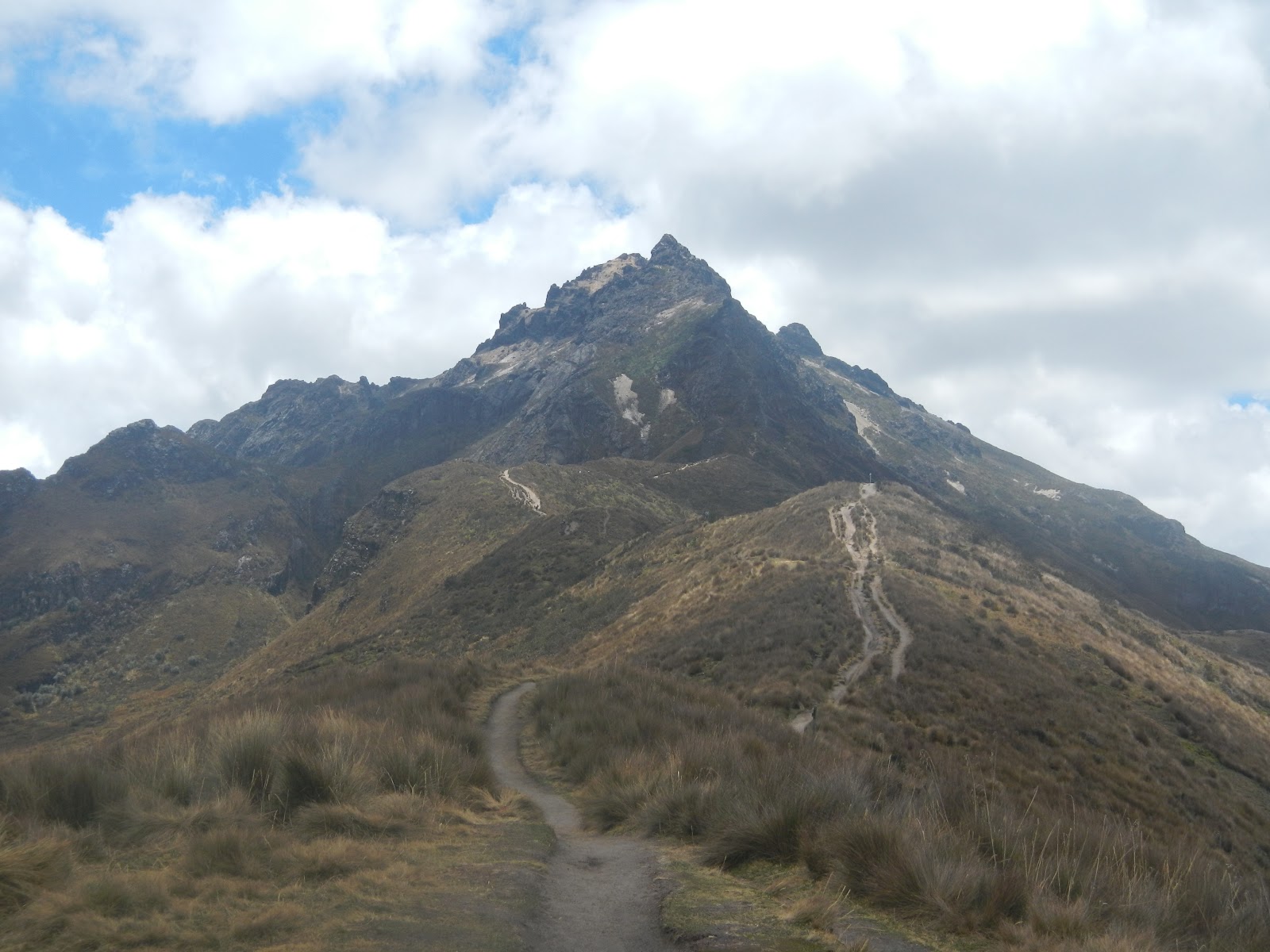
The path to the top, this would be a great place to film Lord of the Rings, just saying.

To the summit!
The last 45 minutes is the real challenge. At that point it turns from an uphill path into crazy steep landslide. Where once there was hard packed dirt and grass, now there is only sand and broken rocks. To quote myself from the trip "Damn this is steep!" At this point it's about as steep or steeper than a double black diamond ski slope to give a reference. Once you tackle the land slide it changes from a hike into rock climbing. This is the point where most people choose to turn back... we didn't.

The landslide portion

No Tobias is not standing on a hill or anything. I was a few feet away from him, this is just how steep it is.

From here you must climb vertically up the rocky face of the summit. This was definitely the scariest part, given that you're rock climbing without a harness or ropes. But it was really really fun, and totally worth it. The summit of Pichincha is a great place to have a picnic, so that's just what we did. The views were amazing, we had a hawk walk only about 10 feet from us, and we met a really cool mountaineering couple up there that showed us an easier way down (basically sliding down the sandy part) and then gave us a ride home. Overall a pretty awesome day, and despite all my whining about how tough the hike was, it was completely worth it, and I would go back without question.

Starting the final ascent.

This is what you have to climb up to get to the summit.

This is what awaits you if you fall.

The view from the top
Mr. Hawk

Made it!

Proof!

Yes I do often picnic at 15,413 feet... I'm pretty cool, no big deal

And now I have to steal a card from Kamila whom I miss very much, and give you a preview of what I will be doing two weekends from now, biking down Cotopaxi!

We have a date, see you in two weeks Cotopaxi!

Friday, September 28, 2012

Botanical Gardens

Past Sunday was an opportunity to see some of the beautiful attractions in Quito, namely the Botanical Gardens. We spent the day walking through the park La Carolina, which is really a beautiful park in its own right, and a wonderful place to spend an afternoon. But the real reason we were there was to visit the gem hidden inside the park, a lovely little botanical garden. The trip was a lot of fun, and the gardens were quite beautiful. They are able to pack a ton of vegetation into a very small area, and display a stunning variety of plant climates. From Amazon to desert, with 365 days a year of sunshine and warm weather it's pretty easy to make a nice garden. I really just wanted to write this to share some of my favorite photos from the trip, so here they are:


Orchids

More orchids

This is what a pineapple plant looks like!

Still more orchids

This room was an insects nightmare, full of carnivorous plants, like these lovely pitcher plants.

Today's word is... Salsa!

This past weekend was spent enjoying beautiful Quito. On Saturday we attended the birthday party of our host Mom Veronica. This had the facade of a simple, classy, boring dinner party. Complete with with Ramada Conference Room B level catering and awkward dry conversation, but that huge dance floor speaker in the corner belied more sinister intentions. And indeed once the plates were cleared and small talk fizzled out the music came on. And in a matter of about 10 minutes the house turned into a hot Latin dance club, hips in full swing. This vodka fueled dance party lasted until about 2AM and actually turned out to be much more fun than I had expected. My program director Maria showed up, and it turns out that she was the life of the party. A full on Latin mama, Maria was stomping those boots and swinging those hips long after most people had collapsed from exhaustion.

One thing about the party that really surprised me was just how stereotypically Latin everything was. I have to give kudos to American comedy shows, because they really are not far off on their Latin American impressions. The title of this post comes from a classic bit on the Colbert Report, where Stephen interviews his Latin-American counterpart, Esteban Colberto, host of the Reportero Colberto Gigante! And his character was pretty spot on, I would say 75% of the guys at the party looked and acted exactly like his impression. I didn't take any pictures from the party, as I didn't want to be that kid standing around snapping photos of other people dancing. So I've added a still from the Reportero Colberto Gigante to give you an idea of what the party looked like. For your reference I have included a link to the bit (Here).

The best facsimile of a picture from the party.

School's In

This week marked my one month anniversary of work at Escuela Aliñambi, so I thought I might share a little about the school and what I do there. For those of you unaware, Aliñambi is the school at which I am currently doing my volunteer work for the foundation. It is called an "Escuela-Jardín Particular Mixta" This means essentially that it is part orphanage, part school, and part farm. The school is for children from the ages of 4-12 (except for the one kid that I swear is either 14 or on steroids) and for most purposes functions like a regular school. Class goes from 7:30AM until 12:30PM with an hour for lunch/recess. Kids learn history, reading, writing, speaking, art, and all of the other basics you should get from elementary school. There is one catch however: remember that "orphanage" part from before, well that is what makes Aliñambi a little different. The children that go there are all in some sort of situation that prevents them from going to public school (usually fairly expensive in Ecuador.) Dead parents, extremely poor families (can't afford food poor), and street children are all very common at Aliñambi. As you might imagine this makes those basic elementary school skills much harder to teach. Most of the kids have absolutely zero education before they enter the school. Many of them do not speak very well, and even the older children often cannot read or write.

More importantly though from the perspective of an educator is the fact that the children have no discipline whatsoever. And who can blame them? It's not their fault that to survive they have focused more on how to steal from figures of authority than how to respect them. To give an example, on my second week there I was asked by the director of the school to "teach some basic English and watch" the second graders for a couple of hours because the teacher had to leave. So there I am alone with a class of 20 six-year-olds who have never met me before and are difficult to control under normal circumstances. Needless to say that it was a complete train wreck. After the first 5 minute honeymoon period they were completely impossible to control. It takes a surprisingly short amount of time for kids to realize that they can take advantage of someone three times their age. So I spent the next 2 hours playing firefighter, just trying to prevent as much damage as possible. Only in this situation it was like fighting a forest fire with a water pistol. For about 30 minutes I was able to keep most of them interested with puzzles (throwing the pieces at each other, not solving them) and reading books (looking at the pictures.) During this period I only had a couple of kids try to fight or escape by climbing out the window. For the last hour however, I was the captain of the Hindenburg. It was all I could do to keep the kids from killing each other, and I wasn't even very successful in that regard. Note: lets keep in mind that these are kids who don't even speak Spanish very well and I would not consider myself fluent in street-child Spanish so I couldn't understand half of what they were saying. Anyways, during that last hour the kids managed to turn the room into what looked like an atomic bomb test site; they destroyed a class project model of the school, two kids escaped through the window, and one kid punched another girl in the face and her nose started bleeding.

Of course I cannot blame the kids for this (well maybe a little), I blame the woman who thought it would be a good idea to put an eighteen-year-old volunteer with no teaching experience in charge of 20 six-year-olds for two hours. Aside from that experience however the school is not all bad. My duties there are basically to say a few basic things in English when I can (good morning, hello) and to act as a teacher's aid for kindergarten. I am starting to develop the eyes in the back of my head that are a prerequisite to being a kindergarten teacher, and I'm getting very good at telling kids to stop fighting and cut it out... but that doesn't always help. Sometimes the kids are just a real pain in the ass. And yes, I realize the irony that you can catch me as a child on the premiere of  "America's Most Annoying Children" coming to TLC this spring. I certainly have a whole new respect for any teacher of young children anywhere, it takes some special form of masochism to want to devote your life to trying to control a bunch of little feral, rabid, energy-sucking monsters.

I have to say though, this experience is certainly an excellent stepping stone and learning opportunity to prepare for my next project: Wild Animal caretaker in the Amazon.